Lieutenant Azhir
Chasing SunlightLieutenant Azhir is a ranking airman of the Cult of Flame and a survivor of the disaster that overtook his ship near the sargasso. His brief appearance turns distant catastrophe into immediate testimony: something from Tor Ilek has already reached the eastern waterways, destroying commanders and leaving desperate crews among wrecks. Azhir’s knowledge of fire dust then gives the Endeavor a practical means of escape, making him less a fully developed companion than a crucial threshold figure whose expertise briefly joins two religious and maritime worlds.
Identity and Appearance
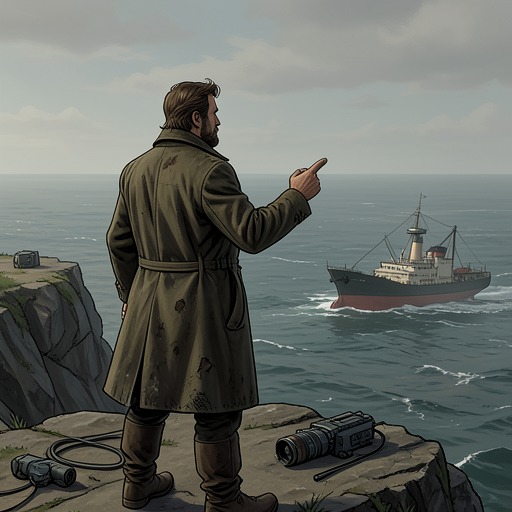
Lieutenant Azhir is identified by his rank and by his allegiance to the Cult of Flame, whose ships and sailors operate according to customs distinct from those of Beacon. He is a southerner, described as short and swarthy, with skin reddened and roughened as though it had been chapped by prolonged exposure to fire. His body bears brands rather than the tattoos common among airmen of Beacon; the symbols on his upper arm record successful voyages. These marks make his identity legible before he has said much, presenting him as a veteran of a maritime culture whose religious and navigational practices differ from those of Jonathan Heights’s expedition.
His command of the language of Beacon is rough but understandable. The difficulty does not prevent him from reporting what happened, but it gives his account a halting, fragmentary quality, reinforced by nervous glances and expressive hand movements. His worn appearance suggests the strain of surviving without sufficient supplies, while his formal response to Captain Montgomery shows that discipline remains intact beneath the exhaustion.
Encounter with the Endeavor
Azhir reaches the Endeavor after Montgomery arranges contact between the two ships. Lines are carried across the gap, a rope bridge is stretched along the tethers, and the lieutenant climbs aboard to meet Montgomery in the canteen. Eleanor McAvey and Jonathan Heights attend the meeting, as does Inquisitor Antomine, whose presence makes the interview more than a simple rescue negotiation. Montgomery needs information about the missing captain, the ship’s route, and the condition of the stranded crew; Azhir must determine whether the Endeavor offers genuine rescue or another danger.
When Montgomery asks what happened to his captain, Azhir explains that the captain was with the deacon when something came from Tor Ilek. He calls it dark fire and says that the deacon invoked the name of the fiery god worshipped by the Cult of Flame. The invocation protected the survivors, but the captain and the deacon disappeared, leaving only scorched shadows. The account is brief and incomplete, yet its implications are immense: the destruction associated with Tor Ilek is not confined to the city itself, and its force has begun to shape the fate of travelers far from its source.
Azhir also explains how his ship reached the sargasso. The crew followed the Khorus River while traveling south, arriving approximately two weeks before the Endeavor’s negotiations with them. Their wrecks and stores had endured only to a limited degree. The route places the Cult of Flame’s vessel in a wider eastern network than the explorers of Beacon fully understand, while also confirming that different peoples may reach the same remote waters by routes unavailable to one another.
Skills and Cooperation
Azhir’s principal practical value is his command of fire dust. When Jonathan offers to burn away the mists and open a route out of the sargasso, he notes that the Cult of Flame’s sailors should possess greater facility with the substance. Azhir confirms that every airman of the Godforge knows how to handle powdered flame. His expertise promises a faster and less hazardous operation than the Endeavor’s crew could manage alone, turning religious knowledge into a concrete technology of survival.
The negotiation is shaped by scarcity. Azhir’s ship has already traded away its supplies, leaving its hold full of metals and spices rather than usable fire dust. Those goods may be valuable elsewhere, but they cannot be burned to clear the mists. The crew therefore has a direct reason to cooperate with the Endeavor. Montgomery asks Azhir to provide four people capable of handling the fire dust, and Azhir agrees immediately despite his worn condition.
His response preserves the hierarchy of his own culture. He rises, salutes with both fists pressed together, and answers Montgomery formally, using a gesture unlike the one-handed salute customary in Beacon. The movement is a small but precise sign that cooperation has not erased difference. Azhir accepts Montgomery’s authority for the immediate operation without abandoning the customs that define him as a Cult of Flame airman.
Religious and Political Context
Azhir’s role is illuminated by the larger opposition between the Cult of Flame and the light-centered order represented by the monarchy, the Lux Guard, and Antomine. The Cult of Flame treats fire dust as familiar working knowledge, while the people of Beacon approach it with greater uncertainty and danger. Their technical exchange therefore crosses a boundary between rival systems of faith and expertise. The Endeavor needs what Azhir knows, even though the ship’s wider mission is entangled with authorities that regard other forms of power with suspicion.
That tension echoes the doctrine voiced by Antomine, who insists that humanity belongs to the light and that corrupting secrets must be purged. Antomine’s hostility toward alien or dark-associated substances is especially visible when he forbids Jonathan Heights from using a potentially useful fruit during the expedition. In contrast, Azhir’s fire dust is treated as a legitimate and mastered resource because it belongs to his own tradition. The difference shows that religious boundaries determine not only what is considered holy or dangerous, but also whose technical knowledge may be trusted.
Azhir is not shown as a theological spokesman in the manner of Antomine, and the evidence does not establish his private beliefs beyond his service within the Cult of Flame. Nevertheless, his speech about the disaster retains the imprint of that culture: the deacon’s invocation is the decisive action in his account, and the surviving crew’s ability to use powdered flame is presented as an ordinary competence of Godforge airmen. His identity is thus carried less by exposition than by ritual vocabulary, bodily marks, shipboard discipline, and command of a sacredly charged material.
Narrative Function and Significance
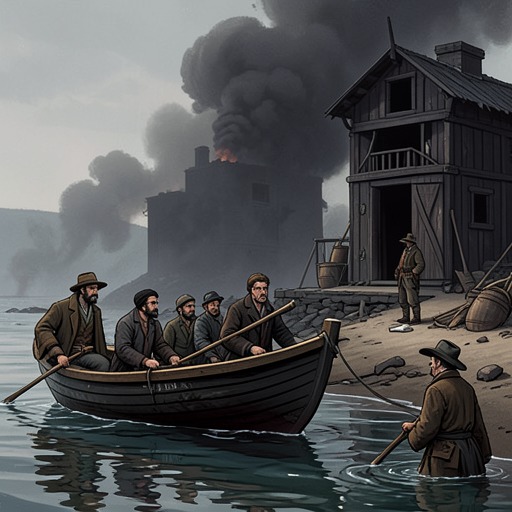
Azhir functions as a survivor-witness, a technical ally, and a messenger from a disaster whose full scale exceeds the immediate scene. His report of the captain and deacon becoming scorched shadows gives the catastrophe of Tor Ilek a human and operational consequence. The event is no longer merely an eastern rumor or a remote threat; it has displaced a crew, consumed its leaders, filled its hold with unusable cargo, and trapped its remaining sailors in the sargasso.
At the same time, Azhir’s appearance emphasizes the expedition’s dependence on people outside Beacon’s official competence. Jonathan Heights knows how to identify a possible route and offers the plan for burning through the mists, but Azhir’s people know how to perform the dangerous work. Their collaboration is therefore reciprocal rather than charitable: the Endeavor supplies knowledge of escape and a route toward Ukaresh, while the Cult of Flame supplies the expertise necessary to make that route usable.
The encounter also provides a restrained contrast with the later confrontation between Jonathan Heights and Antomine at Bright Defile. Antomine’s authority ultimately breaks against the truth of sunlight, where he declares that mastering secrets beyond the Illuminated King’s understanding threatens everything the king has built. Azhir, by contrast, enters the story at a moment when cooperation across competing systems remains possible. His practical command of fire dust temporarily overcomes religious and political suspicion, even as the catastrophe surrounding Tor Ilek warns that every such alliance operates under pressures larger than the people making it.
Azhir’s final fate is not given in the supplied account. He remains important not because the narrative follows a long personal transformation, but because his testimony and skill connect the Endeavor to the wider eastern crisis. Through him, a stranger’s damaged ship becomes a source of knowledge, a technical exchange becomes a rescue operation, and the distant violence of Tor Ilek becomes part of the expedition’s immediate reality.